
cybersec.lunch
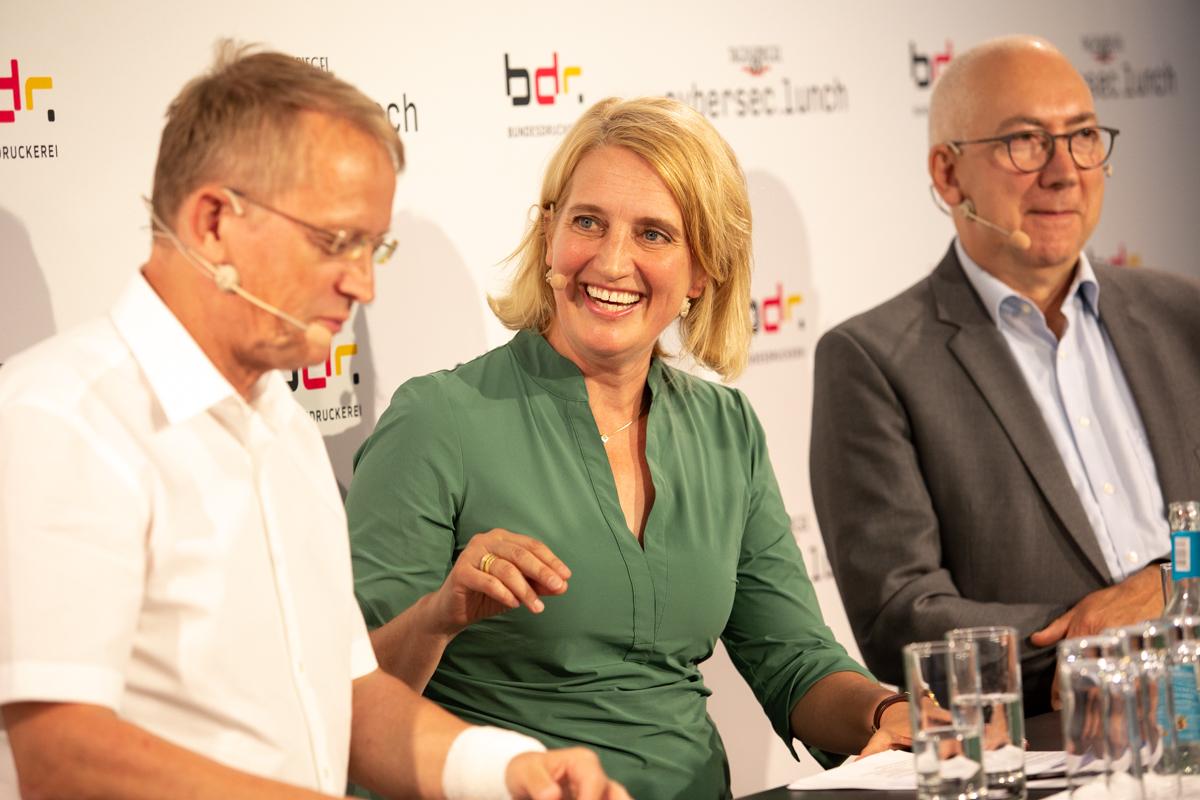
Der cybersec.lunch ist ein seit Februar 2017 regelmäßig stattfindendes Format. Innerhalb einer Mittagspause treffen zwei Sicherheitsexperten aus Politik, Wirtschaft und Wissenschaft aufeinander und gewähren Einsicht in aktuelle Themen der Cybersicherheit und Digitalisierung – von IT-Produktsicherheit bis zur Sicherheit von demokratischen Wahlen. Auf den Podien vergangener Veranstaltung diskutierten unter anderem Klaus Vitt, Staatssekretär im Bundesministerium des Inneren und Beauftragter für Informationstechnik, MdB Saskia Esken, Bundesvorsitzende der SPD und Dr. Ulf Buermeyer, Richter am Landgericht Berlin.
cybersec.lunch#17
German EU Council Presidency – progress for the digital sovereignty of the EU?
Topic:
On 1 July 2020 Germany took over the Presidency of the Council of the European Union for six months.
The focus of the German Presidency lies on coping with the Covid-19 pandemic, with digitalisation taking centre stage as one of the factors of crisis management. The strengthening of digital sovereignty is laid down in the programme of the EU Council Presidency as a leitmotif of the European digital policy. On this basis, the Federal Government wants to expedite a European data strategy together with a data infrastructure, define and legally secure common European data spaces, disclose and regulate platforms and their algorithms more transparently and launch a European Digital Identity.
To facilitate digital networking and the use of technologies in different sectors such as mobility and health safely and viably, Germany and France are advancing with Gaia-X as a European cloud infrastructure system. Data and services are to be made collectively available, aggregated, and shared based on trust.
The current pandemic shows states, businesses and institutions that in view of their digital skills and the development and production of digital key technologies, such as AI and digital platforms, they must be positioned more resiliently, to act in a digitally self-determined manner. It is necessary to address the question how Europe in general and Germany in particular can deal with technological innovations in such a way that we increase competitiveness and prosperity and can at the same time protect personal data without getting into international dependencies. Moreover, questions concerning the opportunities of Germany’s EU Council Presidency and the perspectives of digital sovereignty in Europe arise.
Against this backdrop, we want to discuss the following questions, amongst others, with proven experts:
What is the status of the European digital sovereignty and what can a digital identity in Europe look like?
What are the demands of the business community on European politics, and where do the restrictions of political action lie in the seemingly boundless digital space?
What are the necessary framework conditions for Europe to be able to enforce its values in the digital space and at the same time maintain its competitiveness?
How can European digital standards get worldwide attention and acceptance?
How can the German-French Gaia-X project provide a basis for data analysis, big data and AI, and can it serve as a blueprint for European initiatives?
What contribution can be made by the German EU Council Presidency in the face of major challenges in the wake of the coronavirus pandemic?
What structures should be created in the medium and long term to safeguard the platform regulation on a European basis?
How strong are the international technological-digital dependencies currently, and why is the EU concretely dependent on resources, subsidies, and technological lead?
Speaker:
Kim Jørgensen, Head of Cabinet, European Commission
Pia Karger, Leiterin der Abteilung Digitale Gesellschaft; Informationstechnik as well as IT-Beauftragte,Bundesministeriums des Innern, für Bau und Heimat
Interjection by:
Marco-Alexander Breit, Leiter der Stabstelle Künstliche Intelligenz as well as Leiter des Referates Ökosystem der Künstlichen Intelligenz, Datenverfügbarkeit, Plattformen, Bundesministerium für Wirtschaft und Energie
Presenter:
Stephan-Andreas Casdorff, Editor-Publisher, Der Tagesspiegel
Der cybersec.lunch wird unterstützt von der Bundesdruckerei.

Hinweis zu Film- und Fotoaufnahmen bei Präsenzveranstaltungen
Die Veranstaltung wird dokumentiert. Neben der Wortberichterstattung werden Fotos gemacht. Partner der Veranstaltung fertigen Filmaufnahmen. Mit Ihrer Teilnahme erklären Sie sich damit einverstanden, dass Foto und Filmaufnahmen während der Veranstaltung vom Verlag Der Tagesspiegel GmbH und dem Partner gemacht werden.
Sie sind mit einer zeitlich und räumlich unbeschränkten Nutzung dieser Aufnahmen durch den Verlag oder durch dessen Partner (auch zu Werbezwecken) einverstanden.